
How Indio Directory Searches Start
A useful Indio residents directory search starts with a source choice, not a broad name query. An address points toward the Riverside County property search and the city GIS map. A recorded transfer points toward the Assessor-County Clerk-Recorder index. A past household may call for the Riverside County Library System, regional telephone volumes, census schedules, or an obituary collection. A court question belongs in the Riverside Superior Court portal, where case class and location affect the result. A public affiliation may be checked through a state license or business filing. These are separate trails, and each has its own access rule.
Use a small evidence chain. Keep the exact spelling, a middle initial or former surname, an approximate date, and a stable number such as an APN, document number, case number, license number, or entity number. Then compare a hit with a second official custodian. The goal may be family history, an heir question, a reconnection, a property record, or civic research. A name match alone is not identity proof, and a property owner is not the same thing as every person connected with a parcel.
- Start with the county property search when an address or parcel is known. Capture the APN, situs, assessment year, and visible parcel facts.
- Use the California voter status tool only for a voter’s own record, or use the approved file process when a lawful statutory purpose qualifies.
- Search the recorder by party name, document type, and date. Move to Gateway Riverside for older Riverside County instruments.
- Check court, vital, license, business, or unclaimed-property systems only for the narrow question each system can answer.
- For past residents, pair a dated directory or census entry with a deed, probate, obituary, or permit record before drawing a conclusion.
The full street-by-address sequence belongs on the Indio street directory page. It shows how an address becomes an APN, then an owner lead, then a dated record trail.
Note: A public source can still be incomplete, so keep its access rule beside the result date when comparing an Indio record.
Indio Records Offices Behind the Directory
Indio is not a self-contained records jurisdiction. City Hall is the first stop for municipal agendas, ordinances, permits, planning files, contracts, reports, and correspondence. Riverside County keeps the property roll, recorded instruments, tax records, many clerk filings, and local vital copies. California controls the statewide voter-file rules and vital-record program. Riverside Superior Court keeps the case trail, with an eastern-county public access point in Indio. Routing the question to the right custodian saves time and helps preserve the limits attached to each record.
The Indio public-records page separates published Laserfiche material from a customized Records Requests Portal. Search meeting packets first. A focused request should name the department, record type, subject, and narrow date range. The city gives a statutory determination within ten calendar days, but that is not a promise that production will be complete in ten days. Submission is free; direct duplication or permitted extraction costs may be quoted in advance.
Riverside County Recorder
Assessor-County Clerk-Recorder
Palm Desert ACR counter
800-696-9144
Riverside County Assessor
38-686 El Cerrito Road
Palm Desert, CA 92211
760-863-7800
Address and APN lookup
Riverside Elections
Registrar of Voters
County service and file requests
951-486-7200
City Planning and GIS can be reached at 760-391-4120 and planning@indio.org. The City Clerk assistance line is 760-391-4006, with City Hall listed at 100 Civic Center Mall, Indio, California 92201. The county and state contacts above are different doors, even when one person’s name appears in more than one record set.
Note: Riverside County and the City of Indio answer different questions, so a municipal request cannot replace a county land search.
Indio Property Search Starts with an APN
The Riverside County property search is the best first move when the clue is an Indio street address. Enter the street number and name to locate an assessor parcel number, then retain the APN and situs address together. The online result provides assessment facts, property characteristics, values, a legal description, and a tax-rate area where available. The county deliberately does not display owner names online. Owner identity is available for public inspection at an assessor office when an address or APN is supplied.
The address search is not an occupancy list. Situs means the physical parcel location. A mailing address is where a notice goes and can be different from the parcel. A legal description anchors the land in a subdivision and lot or in a metes-and-bounds description. The annual roll is a dated assessment snapshot. Keep those distinctions visible when reading a property record or when a later deed appears to conflict with a current map.
For a visual look at the address and APN entry point, open the official Riverside County property-search screen.
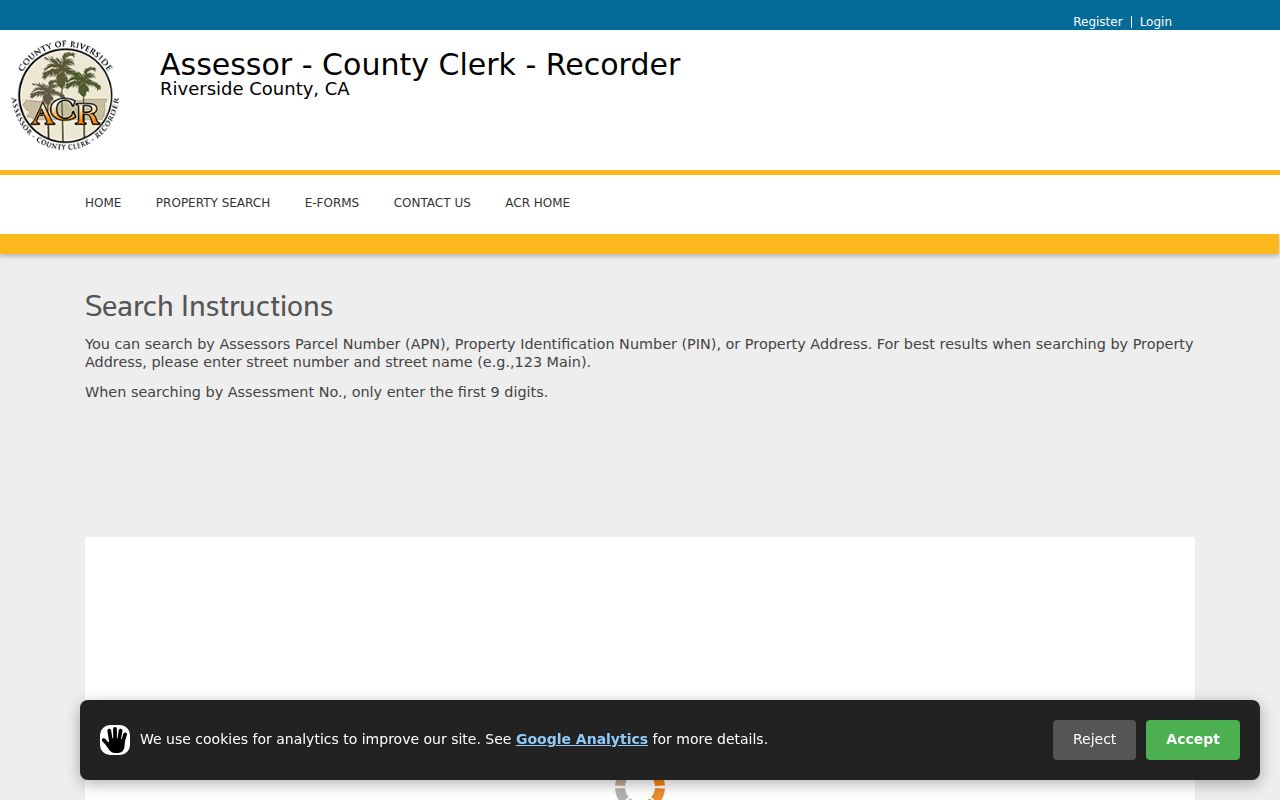
The screen is a locator, not a title opinion. Take the APN to the Assessor counter for the public owner field, then use the owner name in the recorder index if the research question concerns a recorded transfer.
| Search field | Type | Use | Important limit |
|---|---|---|---|
| Street Number | Text | Numbers only in address mode | Pair with street name |
| Street Name | Text | Enter the named street | Omit surplus suffixes when needed |
| City or ZIP | Selector or text | Narrow a result | Postal city can differ from city line |
| APN | Text | Search by county parcel identifier | Follow the displayed formatting |
| Search or Reset | Buttons | Run or clear the query | Owner-name search is not offered online |
The Riverside Recorder’s Indio Trail
The recorder adds a party-and-instrument trail after the parcel search. Riverside County recorder documents are indexed online from January 1, 1974 to the current coverage date shown by the portal. Clerk documents reach back to January 1, 1893 where indexed. Pre-1974 recorder research goes through Gateway Riverside, while the Riverside County Archives can help identify map books, rolls, deeds, grantee indexes, leases, homesteads, surveys, and irrigation-district material by series.
The advanced recorder search accepts document number, recording-date start and end, party name, document types, and an advanced-name checkbox. Use the recorder’s last-name, first-name, middle-initial convention. The search supports exact, wildcard, and sounds-like behavior in the relevant modes. A `*` can widen a starting string, `?` can stand in for a doubtful character, and a trailing `$` can request a phonetic match. These controls matter when initials, compound surnames, accents, or spelling changes affect an older index.
A result is an index locator. It may show the party and role, document number, recording date, type, and book, page, or map reference. The legal description, signatures, consideration, and full instrument substance require the image or copy. Online copies average about 48 hours in the research notes; mail requests take roughly one to two weeks. The listed copy schedule is $8 for the first page, $1 for each added page in the same document, and $2 for certification, with a 2.15% online card charge.
- Record grantor, grantee, trustor, trustee, beneficiary, lien claimant, or debtor role instead of treating every name as an owner.
- Compare the recording date, document number, legal description, and APN before linking one party to one parcel.
- Use a deed to trace a transfer, not to claim that every person at the address was a household member.
- For older records, send the office a complete party set, estimated recording date, document type, and useful APN.
Indio Voter Records Have a Narrow Door
California’s My Voter Status tool is a self-verification service, not an open Indio resident directory. A voter enters first name, last name, date of birth, and one of two conditional identity fields: a California driver license or identification number, or the last four digits of a Social Security number. CAPTCHA protects the form. The authenticated result can show the user’s status, location, party and language preferences, vote-by-mail or provisional information, polling place, election data, and county contact details.
Identifiable voter data is limited to approved election, scholarly, journalistic, political, or governmental purposes under Elections Code §§2188 and 2194. A voter-file application asks for the requester, organization, statutory purpose, scope, security steps, active or inactive selection, voter history, district file, delivery method, proof, and signature. It is not a casual way to browse a street. Driver-license numbers, state ID numbers, Social Security digits, unique identifiers, and signatures are excluded. Confidential voters and Safe at Home participants receive added protection.
That boundary corrects a common myth. A voter-status hit can confirm one voter’s own record, but it cannot be republished as a block roster or used to infer every person at a parcel. Riverside Elections can be reached at 951-486-7200 when the authenticated record needs help. Wait at least 24 hours after an online registration update before treating the status as current.
For the visual self-check entry point, use the official California voter-status form.
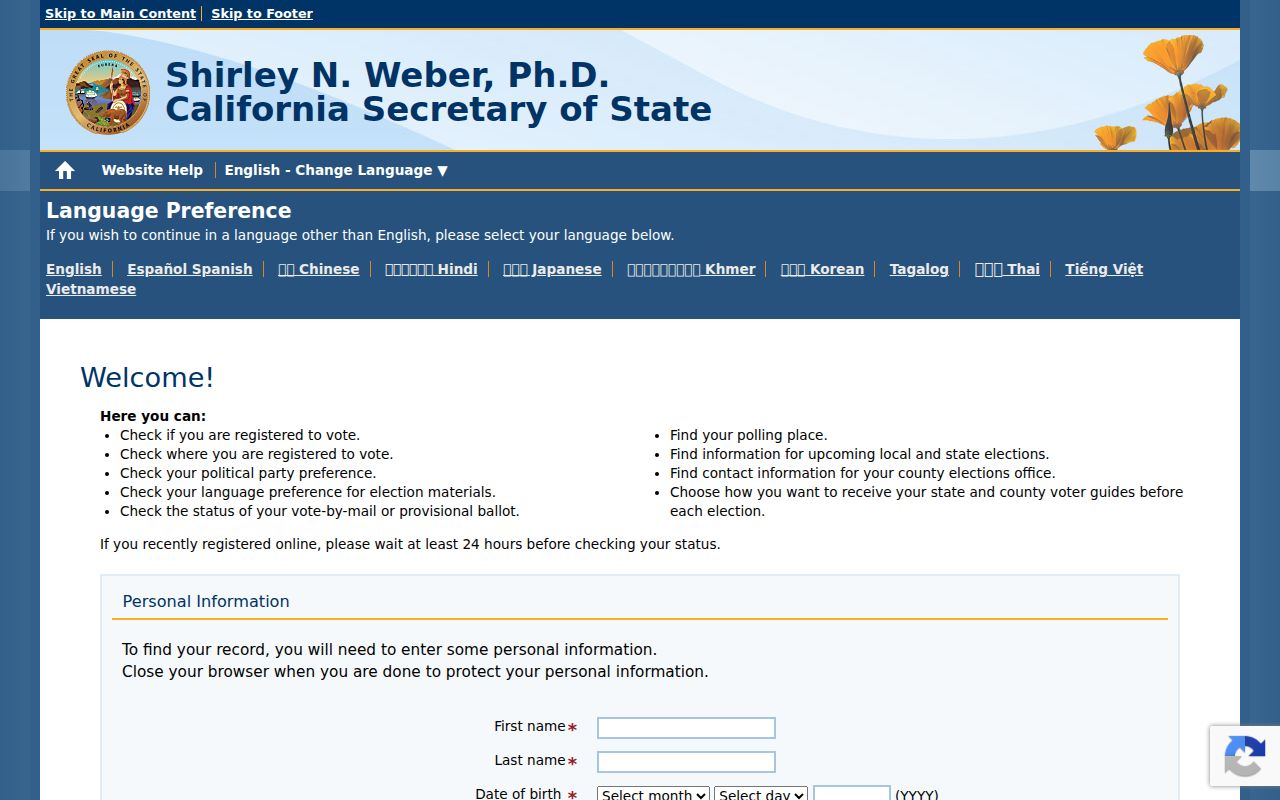
The form’s identity fields show why the service is different from a public name search. It authenticates a voter’s own record rather than exposing a list of Indio residents.
Note: A voter-status result authenticates the voter who enters the form; it is not a public roster of nearby Indio households.
Current Indio Resident Directory Sources
Current Indio residents directory evidence is spread across systems with different custodians and different meanings. The county property roll is strong for a parcel and assessed owner, but the online tool withholds owner names. The recorder ties parties to instruments. City Laserfiche can expose names in public meeting packets, applications, agreements, claims, and staff reports. License and business records can confirm a public affiliation or address of record. Each row below is useful when its evidence matches the question.
| Source | Signal | Keeper | Access path |
|---|---|---|---|
| Property roll | APN, situs, values, characteristics, assessed owner | Riverside Assessor | Address/APN online; owner at office |
| Recorder index | Parties, instruments, dates, document numbers | County ACR | Free index; copies ordered |
| City Laserfiche | Names in agendas, minutes, applications, and reports | Indio City Clerk | Published files or CPRA request |
| License search | Professional name, status, address of record, discipline | California DCA or board | Free public lookup |
| Business filing | Entity status, address, agent, filing history | California Secretary of State | Free search; document access varies |
Use the source that owns the fact. An assessor roll is not a current household list. A license address can be professional. An agent address can belong to a filing service. A city application can show a person’s civic role without showing a private residence. The records become more useful when the query is narrow and the result is dated.
Indio Court Records Have Location Cutoffs
The Riverside Superior Court public portal separates Civil and Small Claims, Criminal and Traffic, Family Law, and Probate. Published Indio coverage begins at different points: civil in May 1991, small claims in April 1994, felonies in May 1990, misdemeanors in September 1993, and purchased family-law indexes in April 1992. Countywide purchased probate indexes begin in March 1994. A missing result can mean an older case, purging, a spelling difference, removal, or confidentiality. It does not prove that no case existed.
The Riverside public-access portal requires a free account. Its Index mode is a paid person or organization lookup. Register of Actions is a free case-number lookup. Calendar shows current and future dates through seven days. Documents are case-number based and paid where the court permits. Probate Notes are updated in the evening three business days before a hearing from documents filed at least four court days before it. Name credits are $1 for one, $3.50 for five, $5 for ten, $25 for 75, or $250 for unlimited use during 30 consecutive days. Case-number searches are free.
Larson Justice Center, 46-200 Oasis Street, handles family law, criminal, traffic, and juvenile matters. It is open Monday through Friday from 7:30 to 4, with clerk phone hours ending at 2, and the court lists public viewing computers and a drop box. Juvenile, sealed, confidential, adoption, and other protected content remains restricted. A docket proves that a similarly named party appears in a case. Confirm identity through location, role, date, and another official record.
Official Indio Records vs Compiled Directories
Compiled directory products can be quick leads, but their source paths may be unclear and their name matches can be stale or blended. Official custodians are slower when a counter visit, account, copy order, or eligibility check is needed. They are still the place to verify a parcel, court event, vital fact, license, business filing, or recorded instrument.
| Question | Official custodian | Compiled directory |
|---|---|---|
| Who is tied to a parcel? | Assessor and recorder, with dates and APN or legal description | May combine names without showing the controlling record |
| What happened in a case? | Court docket, register, or permitted document copy | May omit disposition, protection, or coverage limits |
| Is a public affiliation current? | DCA, a licensing board, or bizfile filing | May preserve an old address or status |
| Who was listed years ago? | Library, census, newspaper, or archival collection | May not identify the edition or page |
Use a compiled result only as a prompt for a custodian search. Save the query date, the official record number, the matching geography, and the visible limit. A short evidence ledger is more reliable than a long unverified profile.
- Roll
- A recurring official list, such as an assessment roll, that records a defined category at a defined time.
- Index
- A finding aid for a larger record or image, not necessarily the full document.
- Parcel
- A mapped unit identified by an APN and tied to situs and legal-description data.
- Criss-cross directory
- A reverse directory arranged by address or street, when a verified local volume exists.
Note: An index locates a record, while the image or certified copy supplies the fuller evidence.
Indio Business and License Trails
Public affiliation questions often have a better answer in a state filing than in a resident roll. The California Department of Consumer Affairs search covers many boards and bureaus. Its basic form accepts board or bureau, license type, license number, business name, first name, and last name. Advanced controls add registry number, selected cities or counties, primary or secondary status, public records, disciplinary actions, and public documents. Board coverage differs, so attorneys, contractors, real estate professionals, teachers, and some health fields use their own official systems.
Open the California DCA license search for the state lookup screen.
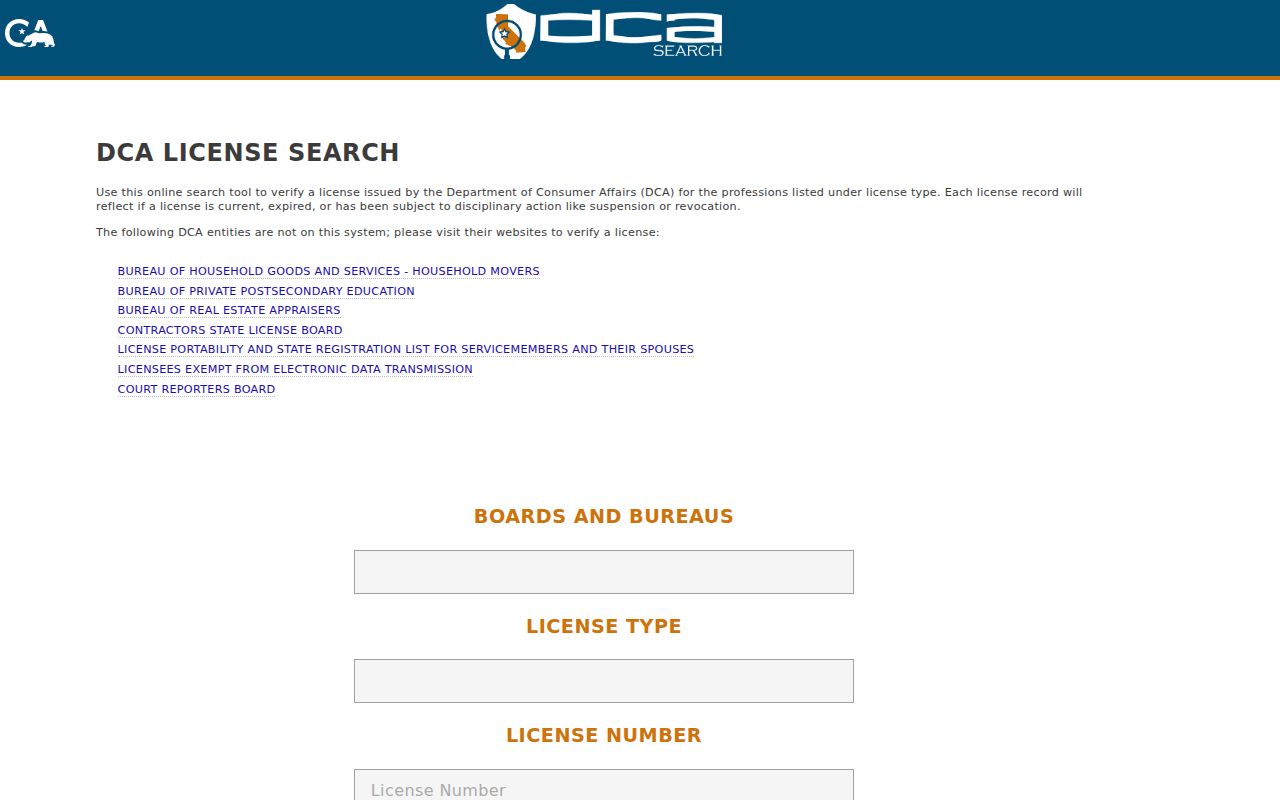
A license result may show a full name, license number and type, status, issue or expiration dates, address of record, and public discipline. An address of record can be a professional or mailing address. It is evidence of an affiliation, not proof of a home or complete household.
Indio Entity Search Has Its Own Fields
California Secretary of State bizfile Online is a separate trail for corporations, limited-liability entities, and other state filings. Its main search accepts a business name or file number, with Business and UCC tabs. Advanced choices include Contains or Starts With, search type, entity type, status, and an initial filing date range. Results are limited to the closest 500 matches unless the query is refined. Entity detail can include the legal name and number, formation or registration date, standing, jurisdiction, street and mailing address, agent for service, statement-of-information due date, filing history, and PDF links.
See the official California bizfile search for the entity-name and file-number entry point.
The filing can verify an entity, an agent, or a public address connection. It does not establish beneficial ownership, a phone number, a private email, or residence. New entities registered after December 22, 2025 use a 12-character identifier beginning with B, while older identifiers remain in use.
Note: An address of record can belong to an agent or business connection, so it should not be relabeled as a home.
Indio Vital Records and Copy Rules
Birth, death, marriage, and divorce records have different custodians and eligibility rules. Riverside County handles local event copies, while the California Department of Public Health statewide vital-records information explains the state route. The 2026 fee schedule lists $31 for birth, $26 for death, $19 for marriage, and $18 for a divorce certificate. The fee remains a search fee when no record is found. A confidential marriage record has no public index or copy route for a casual search; access is limited to a spouse or court order.
The CDPH application page asks for record and copy type, names including names at birth, event date and place, parents’ names where relevant, number of copies, purpose, requester identity and relationship, contact details, signature, and payment. Authorized-copy requests need a sworn statement, and mailed statements must be notarized. Informational copies are marked as not valid to establish identity. CDPH does not email, scan, fax, or itself accept electronic applications. A county order can be faster for an Indio event.
California does not use one universal rule that opens every birth or death record after a set number of years. Access depends on copy type, relationship, record type, and confidentiality status. Preserve that gap rather than assigning a made-up opening date.
Reading Indio’s Historical Directories
Older Indio listings sit inside regional collections rather than a verified, exhaustive Polk shelf run. The Riverside County Library System catalog and reference desk are the best first inquiry for local newspapers, yearbooks, genealogy databases, regional telephone books, and any reverse-directory volume. The Coachella Valley History Museum is another strong institutional lead. Exact Indio city-directory publishers and shelf years were not published in an official online finding aid, so a catalog gap must remain a gap.
Library of Congress records confirm regional telephone-directory runs that include Indio: Riverside County volumes from June 1921 through February 1925, August 1925 through August 1933, and December 1934 through September 1941, followed by Coachella regional volumes from November 1946 through December 1957 and December 1958 through January 1962. A regional reel may require a search for the printed locality heading. White pages can show a subscriber, printed address, and telephone. Yellow pages add a business category. They do not prove ownership, a spouse, or a complete household.
For the full historical shelf method, use the Indio city directories page. A careful entry is recorded with the edition date, locality heading, page, exact spelling, address typography, exchange, and number. A missing name may reflect a move, an unlisted service, a spelling or initial variant, a regional-title mismatch, or a gap between canvass and publication.
Indio’s Pre-1893 Record Map
Indio’s record geography changes with its history. A railroad-depot site was surveyed in 1872, a formal townsite plat was filed in San Diego County in 1888, Riverside County formed on May 9, 1893, and Indio incorporated on May 16, 1930. Because the 1888 plat predates Riverside County, early land and plat work may lead to San Diego County series. Later land, court, vital, and municipal records generally follow Riverside County or the City of Indio.
The split is useful when a present address seems absent from a modern search. Search the county recorder for the post-1893 chain, then look to Gateway Riverside for pre-1974 Riverside instruments. For the townsite era, search San Diego County catalogs and archives for the plat and predecessor land records. Pair those records with federal railroad, homestead, census, or military collections when a historical question calls for a wider frame.
Indio’s growth also leaves layers in the present record. The older civic and railroad core sits around Oasis, Miles, Indio Boulevard, and Highway 111. Later development extends north across I-10, while city, sphere, county, tribal, and postal boundaries can differ. A location label is a routing clue, not a claim that every custodian uses the same boundary.
Indio Privacy Protections Break the Trail
Some missing links are deliberate. California’s Safe at Home program can provide a substitute mailing address and support confidential voter registration for eligible survivors and threatened public groups. Confidential voter records and protected court, vital, juvenile, adoption, victim, and DMV information should not be treated as search failures. The California Consumer Privacy Act and California Privacy Rights Act also provide rights that can include access, deletion, correction, opt-out of sale or sharing, and limits on sensitive data, subject to scope and exceptions.
California’s 2026 Delete Request and Opt-out Platform, called DROP, opened January 1, 2026. A user verifies through the California Identity Gateway and may provide names, former names, birth date, ZIP codes, email, phone, advertising IDs, connected-TV IDs, or a VIN. Beginning August 1, 2026, registered data brokers must retrieve and process requests at least every 45 days. Keep the request ID and any result status. These privacy tools affect compiled directory visibility, but they cannot erase every historic public document.
Lawful personal use. Indio records are for focused, lawful research such as family history, civic review, a personal property question, or an official copy request. Do not use a name, address, voter record, or map to stalk, harass, intimidate, or harm another person.
When a record matters, verify with the custodian that owns it. Use the assessor for its roll, the recorder for an instrument, the court for a docket, CDPH or the county for a vital copy, and the licensing board for license status. The strongest Indio residents directory result is a dated, narrow, two-source trail with its limits written down.