
Indio's City Directory Shelf
Indio does not have an officially published, exhaustive online finding aid for a Polk or other local city-directory run. The verified evidence begins with regional telephone directories that place Indio inside Riverside County or Coachella Valley volumes. The Library of Congress catalog gives the strongest date trail, while the Riverside County Library System and the Coachella Valley History Museum are the practical places to ask about uncataloged local material. The table separates proven runs from the still-open question of a dedicated Indio reverse directory.
| Collection | Years | Where Held | Access |
|---|---|---|---|
| Riverside County white and yellow pages | June 1921 to February 1925 | Library of Congress | Cataloged regional reel; search for Indio |
| Riverside County white and yellow pages | August 1925 to August 1933 | Library of Congress | Cataloged regional reel; search for Indio |
| Riverside County through Riverside | December 1934 to September 1941 | Library of Congress | Regional reel; check the locality index |
| Coachella regional white and yellow pages | November 1946 to December 1957 | Library of Congress | Regional reel; search within the issue |
| Coachella regional white and yellow pages | December 1958 to January 1962 | Library of Congress | Regional reel; compare nearby issues |
These rows are telephone-directory evidence, not proof that a named Polk or criss-cross publisher served Indio. A catalog gap separates September 1941 from November 1946. That gap is a prompt to search newspapers, deeds, vital files, and library shelves, not permission to claim a missing volume or a vacant home.
Indio Regional Telephone Directories
The early Riverside County reels cover June 1921 through September 1941 in three catalog groupings. Indio is not always in the title, so open the printed locality or exchange index before deciding that an issue has no local entry. The later Coachella regional reels resume in November 1946 and run through January 1962. Search every relevant issue because exchange coverage and the printed heading can change.
Each verified city directory entry should capture only fields supported by the collection type. White pages can supply a subscriber name, printed address, and telephone number. Yellow pages add a business heading or category. A directory line is evidence that a name and number were printed together. It does not establish a complete household, legal ownership, a relationship, or present residence.
| Subscriber | Name exactly as printed, including initials or compound-surname order |
|---|---|
| Printed address | House number and street text as shown in that issue |
| Telephone | Exchange and number, when the page displays both |
| Yellow-page heading | Business category, when the entry appears in the classified section |
Use the cataloged 1921 to 1925 Riverside County reel, 1925 to 1933 reel, and 1934 to 1941 regional reel as separate searches. The later 1946 to 1957 Coachella run and 1958 to 1962 run should be logged the same way. No actual Indio line and same-volume abbreviation page was available for inspection, so no sample subscriber is invented here.
Note: Regional coverage can contain Indio without naming Indio on the cover, so the locality index matters as much as the catalog title.
Indio Library and Museum Leads
Indio Library is part of the Riverside County Library System. RCLS asks researchers to use its catalog and reference help for regional telephone books, yearbooks, obituary and newspaper indexes, reverse directories, and licensed genealogy databases. For a city directory request, ask staff to search title variants such as Indio, Coachella Valley, Palm Springs-Indio, and Riverside County. The library’s history places early service in residents’ homes and the Fargo Street Post Office in 1914, a Woman’s Club county branch in 1928, a move to the McCandless library in 1976, a 2017 renovation, and a new building next to City Hall in 2025. Those milestones explain why a shelf lead may sit with staff rather than in a simple online list.
The Riverside County Library System catalog and digital-resources entry point is the right first stop for a title or year request.
The library view reinforces the access path: ask for a regional title, the printed issue date, and any reverse or local-history material that is not exposed by a broad catalog search.
The Coachella Valley History Museum holds Woman’s Club of Indio records beginning in 1912 on acid-free paper. University special-collections catalogs, California Revealed, the Riverside County Archives, and the FamilySearch place catalog add discovery routes for photographs, organization papers, maps, probate, vital material, and place-based records. A library or archive can describe a collection without making every page available from home.
Note: A catalog entry proves that a collection is described; it does not promise that every volume is digitized or immediately viewable.
Reading Indio Directory Entries
A twentieth-century city-directory convention can be richer than the verified Indio telephone inventory, so every mark must be checked against the same volume’s front matter. An entry may carry a surname and given name, a spouse in parentheses, a printed occupation field, a street address, a residence or owner mark, a widow notation, and a cross-reference. None of those conventions should be treated as an Indio publisher rule until a real local volume is inspected.
| Name | Copy the surname, given name, initials, and alternate spelling exactly |
|---|---|
| Family note | A spouse or widow notation may appear in parentheses or abbreviated form |
| Address | Record the house number and street before normalizing punctuation |
| Residence mark | Note any publisher symbol that distinguishes a home or business listing |
| Printed occupation | Optional in broader city-directory conventions; not verified for Indio reels |
- Criss-cross directory
- An address-first section that lets a researcher start with a street and see listed names. No Indio publisher or year run is verified.
- Householder index
- A name-based list centered on the person or household the publisher chose to print. It may omit other people at the same address.
- Abbreviation key
- The volume’s own list of shortened words and symbols. Photograph or transcribe it before interpreting any line.
- Directory image
- The scanned or filmed page that lets a researcher verify type, punctuation, placement, and nearby entries instead of relying on a catalog title.
Read the alphabetical section and any street-order section independently. A name can disappear because of a move, a changed surname, an unlisted telephone, a regional reassignment, spelling variation, or a publication gap. The absence of a line is not a finding that no person lived at an address.
Indio Sanborn Maps Date Buildings
The Library of Congress catalog has exact Indio Sanborn editions for June 1928 and June 1939. Use the sheet index and legend to locate a structure, describe its footprint and recorded use, and compare changes across the two dates. A Sanborn map is a building and land-use source. It does not name occupants, prove ownership, or turn a street label into a resident entry.
The Library of Congress Sanborn search guide shows how to work from city, date, sheet, and availability details. The June 1928 catalog record and June 1939 catalog record are the exact Indio map entries.
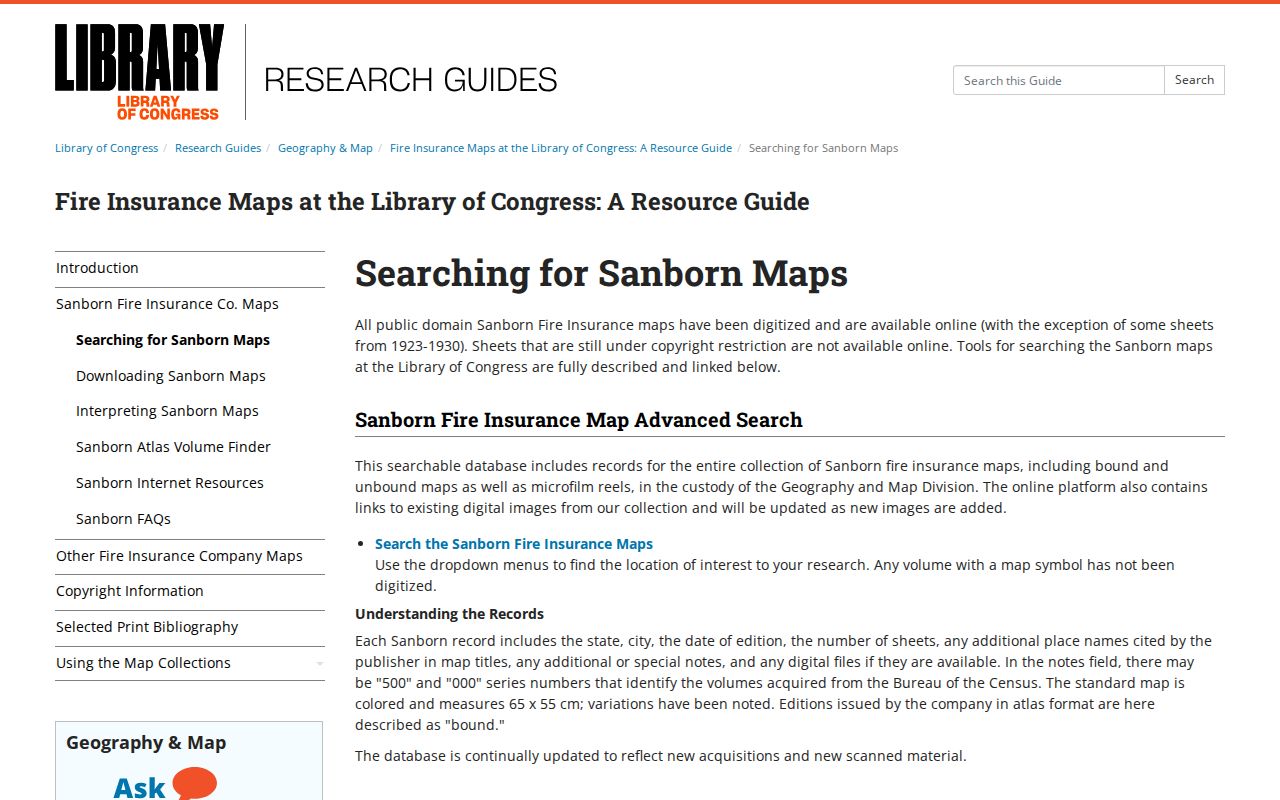
For Indio house history, pair the map’s structure date with the nearest verified directory listing, a deed or legal description, and a permit record. The map can test whether a printed address had a mapped building; it cannot fill an uninspected directory gap.
Indio City Directories with Census Years
Federal census schedules provide ten-year household snapshots, while a city directory can fill some years between them. The National Archives census guidance applies a 72-year release rule, making 1950 the latest open population census in the research record. The FamilySearch place catalog can point to Riverside birth, death, marriage, land, probate, court, vital, and directory material, but an icon may mean online access, a FamilySearch Center, or microfilm-only access.
Use the directory and census as two records with different methods. A directory reflects a publisher’s canvass or telephone subscription. A census reflects enumeration on a particular date. Both can miss people, and neither should be stretched into proof of title or a complete household.
- Choose a known person, address, or year and write down the source title and issue date.
- Copy the printed name and address verbatim before trying surname or street variants.
- Compare adjacent available issues to bracket a move, name change, or regional-title shift.
- Pair the listing with the nearest open census year, checking household names and relationships without assuming identity from one match.
- Close a historical trail with a library obituary or newspaper index, probate record, vital record, or cemetery source, then seek the custodian’s copy when eligibility permits.
For a modern address chain, the historical directory should hand off to recorded instruments and parcel research. The Indio resident lookup path is better suited when the question shifts from a household’s past listing to verification of one person.
Note: A census year and a directory issue capture different dates and methods, so agreement is useful without making either source complete.
The 1888 Indio Plat
Indio’s records have a jurisdictional time line that changes where a directory clue should lead. The official Indio city history places the town in a surveyed railroad-depot setting that gained Southern Pacific service and a formal townsite plat filed in San Diego County before Riverside County existed. Riverside County formed in 1893, and Indio incorporated in 1930. A family search that starts before the county’s formation therefore needs predecessor-jurisdiction research rather than a modern county-only query.
- 1872: the surveyed railroad-depot location creates an early federal, railroad, and land context.
- 1888: the Indio townsite plat is filed through San Diego County.
- 1893: Riverside County forms from San Bernardino and San Diego territory.
- 1928: the first verified Indio Sanborn edition supplies a mapped-structure checkpoint.
- 1930: Indio incorporates, adding a city record layer for later minutes and ordinances.
- 1939: the second verified Sanborn edition supplies a later mapped-structure checkpoint.
No authoritative evidence of an Indio or Riverside courthouse fire, flood, WPA reconstruction project, or comprehensive record loss was located. Keep that absence as a research limit, not as a claim that every early record survived.
Note: Before 1893, the predecessor county is part of the search key, not a footnote to a modern Riverside query.
Indio Directory Gaps and Checks
The exact Indio Polk or criss-cross publishers, a complete local year run, and a verified sample entry were not published in the official finding aids located for this project. The safe method is to label those items as unverified and ask the institution holding the shelf. Search title variants rather than assuming that “Indio directory” is the catalog heading.
- Ask Indio Library or RCLS for “Indio directory,” “Coachella Valley directory,” “Palm Springs-Indio directory,” and “Riverside County telephone directory.”
- Ask the Coachella Valley History Museum about organization records and local ephemera that may not appear in a library catalog.
- Search FamilySearch by California, Riverside and then the land, probate, court, vital, and directory categories.
- Check university special collections, state archival catalogs, and Riverside County Archives for maps, newspapers, and organizational records.
- Log each catalog restriction. An online icon, a FamilySearch Center icon, and a microfilm-only notice do not mean the same access.
The cataloged break after September 1941 and before November 1946 can be bridged with deeds, newspapers, marriage and death files, and voter material only when the applicable access rule allows it. A missing directory year is not proof that no issue existed or that an address had no occupants.
Note: A directory listing proves a printed listing, not legal title, a full household, or a current address.