
Indio Sources for Previous Residents
Previous residents of one Indio address leave different traces in different eras. The deed record follows an instrument and its parties. A telephone directory follows a subscriber. A census schedule records an enumerated household, while a permit file can date work and name an applicant or contact. The table keeps those roles apart.
| Source | Years It Covers | Where Held | What It Shows |
|---|---|---|---|
| Assessor roll and property search | Current January 1 snapshot | Riverside County Assessor; online search and office | APN, situs, legal description, assessment facts, owner at office |
| Recorder index and copies | Recorder 1974-present; clerk records 1893-present | Riverside ACR, Palm Desert, Gateway Riverside | Parties, instruments, dates, images or copies |
| Regional telephone directories | 1921-1941; 1946-1962 | LOC, RCLS, Indio Library research path | Subscriber, printed address, telephone |
| Federal census schedules | 1900-1950 open schedules | NARA, FamilySearch, institutional access | Enumerated household at ten-year intervals |
| City permits and CPRA files | Current and historical coverage varies | Indio Building and Safety; City Clerk | Applicants, contacts, project dates, inspection trail |
| Archives and early land records | 1893 and earlier series vary | Gateway, Riverside County Archives, San Diego County | Older deeds, maps, indexes, and predecessor-jurisdiction clues |
Start with the assessor and recorder for a recent chain. Use the Riverside County Library System, regional reels, and the National Archives census route for listed households. The FamilySearch Catalog can show whether a place collection is online, restricted, or microfilm-only. For an older Indio parcel, ask the county archive or predecessor county route before assuming that a missing online hit means the address had no prior resident.
The Riverside Recorder name and document search shows the starting modes for the modern land trail.
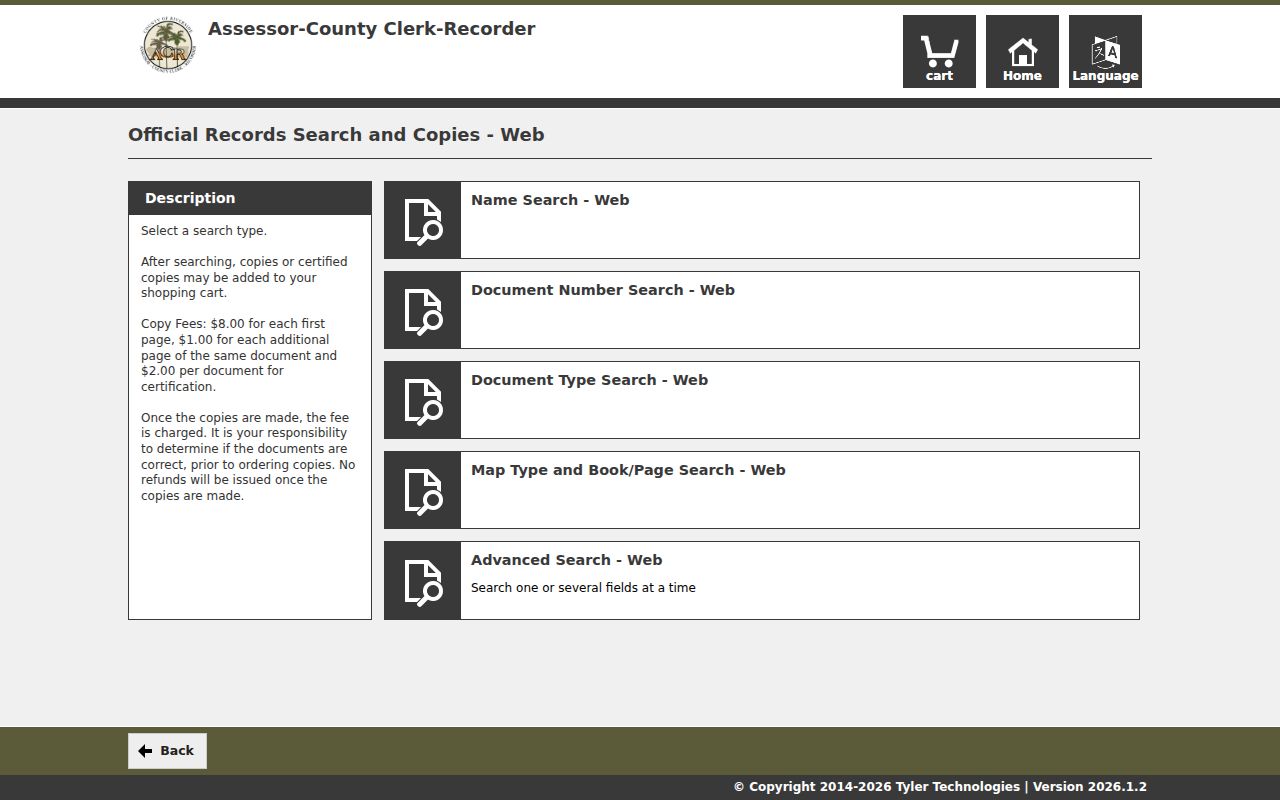
The recorder screen is an index gateway. It does not replace the deed image, the legal description, or a second source for household history.
Note: A current recorder result can start a historical trail, but it cannot by itself establish who occupied an address in an earlier year.
Indio Recorder Records Since 1974
The useful numbers are jurisdiction and access cutoffs, not a promise that the land trail starts in 1974. Riverside County recorder documents are indexed from January 1, 1974. Clerk documents reach January 1, 1893. Office computers search back to 1975, and the county directs 1974 and earlier recorder research to Gateway Riverside.
The free index uses Name, Document Number, Document Type, Map Type, Book/Page, and Advanced modes. A name is entered in last, first, middle order. Wildcard and phonetic operators can help with compound surnames, initials, and spelling drift. Search a likely grantee, then inspect the party role and document date before treating the result as a prior resident lead.
| Online copy order | Average processing is about 48 hours; card orders add 2.15 percent. |
|---|---|
| Mail copy order | Usually about one to two weeks; send parties, date, type, and APN when known. |
| Counter or office research | Palm Desert handles current access; Gateway Riverside is the route for earlier recorder research. |
Regular copies cost $8 for the first page and $1 for each added page in the same document. Certification adds $2. The ACR copy instructions also list phone help at 800-696-9144 or 951-486-7000 on weekdays from 8 a.m. to 5 p.m.
Walk an Indio Deed Chain Backward
For previous residents, the safest path runs from a known parcel to a recorded party, then from that party to the earlier instrument. The address alone is not the chain. Normalize the parcel first, and keep each document number and legal description in a dated ledger.
- Search the address in the county property tool and Indio GIS. Save the APN, situs, and legal description.
- Take the address or APN to a Riverside Assessor office. Owner names are public at the office, but intentionally withheld from the online property result.
- Search that name as a grantee in the recorder index. Narrow by deed type and the likely recording period.
- Read the deed image or copy for grantor, grantee, date, document number, and legal description.
- Search the grantor as an earlier grantee. Repeat until the online cutoff, then move to Gateway or archive staff.
- Grantor
- The party transferring an interest in a recorded instrument.
- Grantee
- The party receiving that interest. A grantee is a recorded role, not proof of occupancy.
- Chain of title
- The linked sequence of recorded transfers for one parcel or legal description.
- Legal description
- The land description used to identify the parcel through lot, tract, or metes-and-bounds terms.
- Criss-cross directory
- A reverse directory arranged by street or address rather than only by surname.
- Enumeration district
- A Census area assigned to an enumerator. It helps locate a household when an old address is hard to match.
For the current chain, the Indio by-street address records provide the modern parcel starting point. Keep the backward trail separate from a claim about every person who lived there.
Note: A grantor or grantee is a recorded role, not a finding about daily presence at the parcel.
Indio Resident and Legal Records
A street address can change form. A mailing address can point somewhere else. The legal description is the better bridge when an old deed, subdivision map, or parcel record uses different street text. An APN helps the assessor locate a parcel, but it is not a permanent substitute for the legal description.
Compare situs, mailing address, APN, tract or lot language, and recording date in every step. A January 1 assessment roll is a dated ownership snapshot. A deed records an instrument. A directory lists a subscriber or household member. A permit identifies a project participant. Those facts can align, but none by itself proves who occupied the address.
Note: A matching deed and APN can establish a recorded acquisition while leaving household membership and daily presence unresolved.
Pair Indio Directories with Census Years
Regional telephone directories supply a useful but narrow household clue. Verified Library of Congress Riverside County issues include June 1921 through February 1925, and the next cataloged run covers August 1925 through August 1933. A later Riverside County run reaches September 1941. Coachella regional runs then cover November 1946 through December 1957 and December 1958 through January 1962.
These are telephone directories, not verified Polk or criss-cross runs. They can show a subscriber, printed address, and telephone. They do not prove a complete household. RCLS and the Indio Library are the local route for regional books, newspapers, yearbooks, and subscription genealogy tools. The exact Indio shelf years were not confirmed in an official online finding aid.
- Record the issue date, locality heading, page, spelling, address form, exchange, and number.
- Pair the directory entry with a nearby open Census year, such as 1930, 1940, or 1950.
- Compare the address and names without carrying a subscriber forward silently.
- Check deeds, permits, obituaries, or probate when a move or death may explain a change.
The Indio city directories page can hold the collection-reading detail, while the backward trail here asks whether one address connects across years and which previous residents appear in each source. NARA’s 72-year rule makes 1950 the latest open federal population census in the research record.
Note: A directory and a census can reinforce a household clue while still reflecting different dates, methods, and coverage limits.
Indio Resident Records: Permits and Maps
Permits can date a change to a structure and name an applicant, contractor, owner, or contact. Inside city limits, Indio Building and Safety or the City Clerk’s public-records route is the right starting point. County TLMA permit lookup applies chiefly to unincorporated land, so check the city boundary before selecting an office.
City applications have been online-only through Citizen Self Service since January 2024, but the city directs people seeking permit history or public property records to its Public Records Center and City Clerk request route. Ask for an existing file by address or APN, a record type, and a narrow date range rather than asking an office to identify all previous residents.
The Library of Congress Sanborn search guide leads to Indio records for June 1928 and June 1939. Sanborn sheets show structures and uses, not occupants. A map can test whether a building stood at a point in time, while a deed, directory, census, or obituary must carry the people trail.
Note: A mapped structure can anchor house history, but the people trail still needs a dated name-bearing source.
Indio Previous-Resident County Boundary
Indio’s California past-resident trail has a real jurisdiction break. The town was surveyed for a railroad depot in 1872, platted in 1888 with the San Diego County Recorder, and transferred into new Riverside County in 1893. Indio incorporated on May 16, 1930. The Riverside County history record and the city history record provide the institutional context. A deed or probate search before 1893 can therefore lead to San Diego County series rather than a Riverside index.
The Riverside County Archives catalogs assessor map books and rolls, deeds and official records, homesteads, leases, ownership records, grantee indexes, chattel mortgages, surveys, and irrigation-district certificates. Exact years vary by series, so staff confirmation matters. The archive route is a fallback when an online search stops at the wrong county boundary.
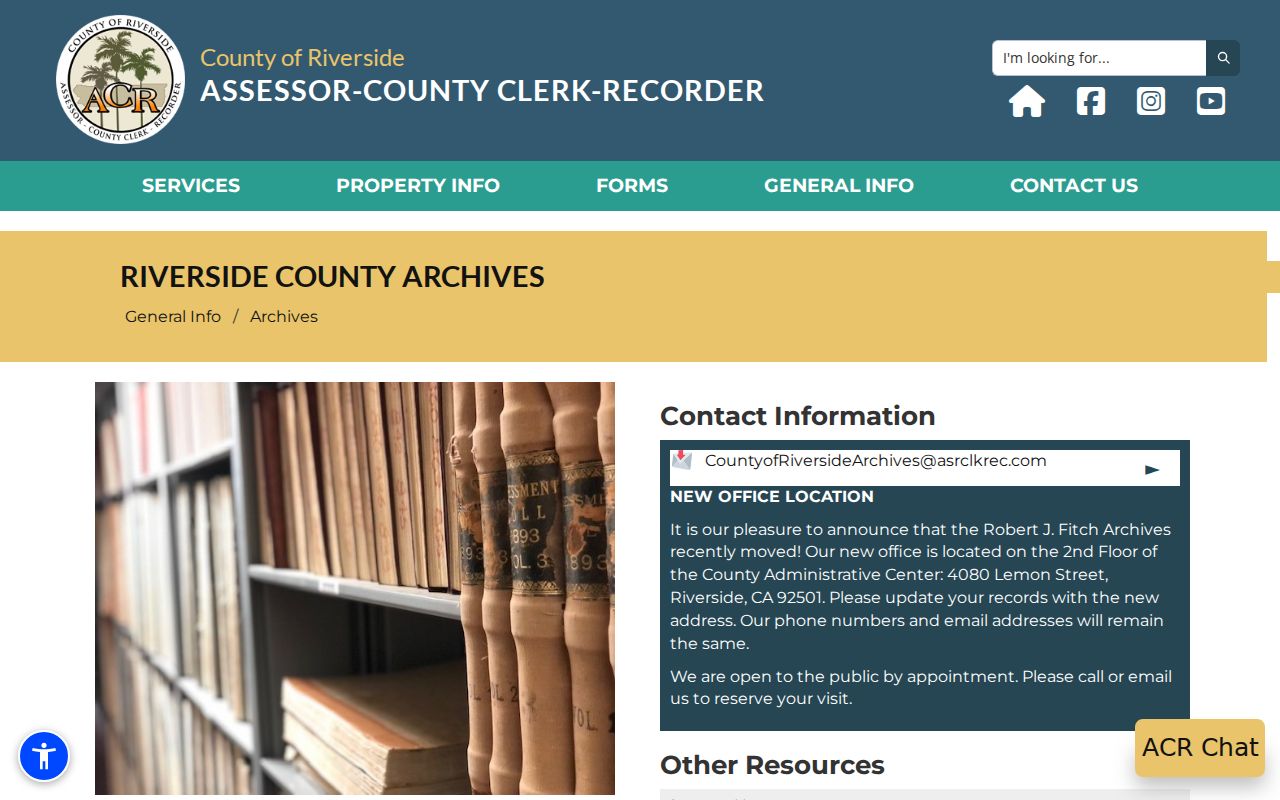
The archive view represents the older record shelf. It can connect a parcel story to the right series without pretending that every early item is name-indexed online.
Note: A county boundary change can move the search to a different custodian even when the present-day address has not changed.
Indio Past-Resident Gaps
A directory gap can mean a regional title change, an unlisted telephone, a spelling or initial shift, a move between canvass and publication, or a missing issue. The 1941 to 1946 break in the verified telephone runs is a catalog gap, not proof that an Indio address stood empty. The research also did not verify a complete local Polk or reverse-directory run, so those years must remain open questions.
When the trail reaches a death or transfer, use Coachella Valley newspapers, obituary files, Riverside Superior Court probate access, and recorder instruments together. Probate can identify an estate, representative, or heir in an open filing. It still does not prove that every named person lived at the address. Keep the source date and role for each result.
Law-enforcement locators are a separate, narrow clue. The Riverside Sheriff inmate system provides a custody snapshot, while the California Department of Corrections and Rehabilitation locator covers state-prison records. A booking, custody, parole, or release field does not prove that someone lived at an Indio address, and an arrest is not a conviction.
Lawful personal use. Previous-resident research in Indio can support family history, house history, heir work, or a dated record check. Do not use records to stalk, harass, threaten, or track a living person.