
Indio Resident Lookup Records
A useful Indio resident lookup starts by matching the question to the custodian. The assessor can connect an address or APN to an assessed owner at an office, while the online property tool supplies parcel and assessment facts. The recorder connects a party name to an instrument and date. A court docket shows a party’s role and case chronology. Vital records confirm an event only under the right copy and eligibility rules. Business and license systems show a public affiliation, not a home. Voter records are tightly qualified. The distinctions prevent a plausible name from becoming an unsupported identity claim.
| Record | What It Confirms | Where | Access |
|---|---|---|---|
| Assessor roll | Assessed ownership and the mailing or situs distinction | Riverside County Property Search and assessor office | APN/address online; owner office-only |
| Recorder index | Party name tied to a recorded instrument and date | ACR Self-Service and Gateway Riverside | Web index 1974-present; older research at Gateway |
| Court docket | Party name, role, case chronology, hearings, and status | Riverside Superior Court Public Portal | Case-number search free; name lookup credits and rules apply |
| Voter file | Registration, residence, status, and precinct data | California SOS or Riverside Registrar | Own-status tool; other access needs an approved purpose |
| Vital copy or index | Event identity, date, and place | Riverside County or CDPH | Eligibility and copy type control access |
| Business or license file | Entity, credential, affiliation, or address of record | bizfile, DCA, or a profession board | Public search; filings and board rules vary |
| Probate or historical directory | Estate, heir, listed occupant, or household clue | Court, library, FamilySearch, or archives | Collection and record restrictions apply |
If you have an address, test the APN and assessed owner before searching a common name. If you have a case number, use the court register before buying a name search. If the question concerns a birth, death, marriage, or divorce, identify the event and the requester’s eligibility first. These choices save time and keep an Indio resident lookup within the source’s purpose.
Note: The record type determines both what a match means and which office can certify or correct it.
Riverside Court Search Modes
The Riverside Superior Court public portal separates Civil and Small Claims, Criminal and Traffic, Family Law, and Probate. Indio’s published electronic ranges begin with civil cases in May 1991, felonies in May 1990, misdemeanors in September 1993, small claims in April 1994, and family-law purchased indexes in April 1992. Countywide purchased probate indexes begin in March 1994. A missing result can mean an older case, a spelling issue, purging, removal, or confidentiality.
The Riverside Superior Court Public Portal requires a free account and offers five distinct modes. Index is the paid person or organization-name lookup. Register of Actions is a free case-number lookup with document and event listings. Calendar shows current and future dates through seven days. Documents provides paid, case-number-based downloads when court rules allow. Probate Notes are updated in the evening three business days before a hearing, using documents filed at least four court days before it.
| Case type | Choose Civil, Criminal, Family, Probate, or Traffic before searching |
|---|---|
| Party or name | Paid name lookup; use name variants and inspect up to ten matching cases |
| Case number | Strongest identifier; Register of Actions lookup is free |
| Filing or date range | Narrow only within the coverage of the selected case class and branch |
| Location | Distinguish Indio, Riverside, Palm Springs, and other court locations |
Name-credit prices are $1 for one, $3.50 for five, $5 for ten, $25 for 75, or $250 for unlimited use during 30 consecutive days. The portal limits activity to 30 searches or lookups in five minutes. Electronic document copies cost $1 per page for the first five pages, then $0.50 per page, capped at $50 per document under Government Code §68150(h). A download remains accessible for 30 days. The court’s purchased-index guidance explains the date ranges and name-index contents available for purchase.
When the portal is not enough, the court’s RI-MC002 record-search and copy form accepts a requester name and address, court location, case number if known, party names, case type, a beginning and ending year, and a Records Search or Copy Work request. It can be mailed or delivered in person. The form lists a $15 clerk name search, $0.50 paper copies, $40 certification, $15 for a certified divorce decree, $50 exemplification, $32 off-site retrieval, and postage or a self-addressed stamped envelope for mail requests.
The court screen shows the search categories and branch context in the court’s public-access instructions. The Larson Justice Center in Indio, at 46-200 Oasis Street, supplies public viewing computers, a drop box, and clerk assistance Monday through Friday from 7:30 to 4; clerk phone hours end at 2. The courthouse phone is 760-393-2617.
For a federal case involving a person or entity, use PACER for the federal docket route and the U.S. District Court for the Central District of California for court-specific filing and access information. Federal case presence is a separate record trail and does not establish an Indio address.
The Riverside Superior Court public portal view is the source for the screen below. It is a search aid, not a substitute for the clerk-held file.
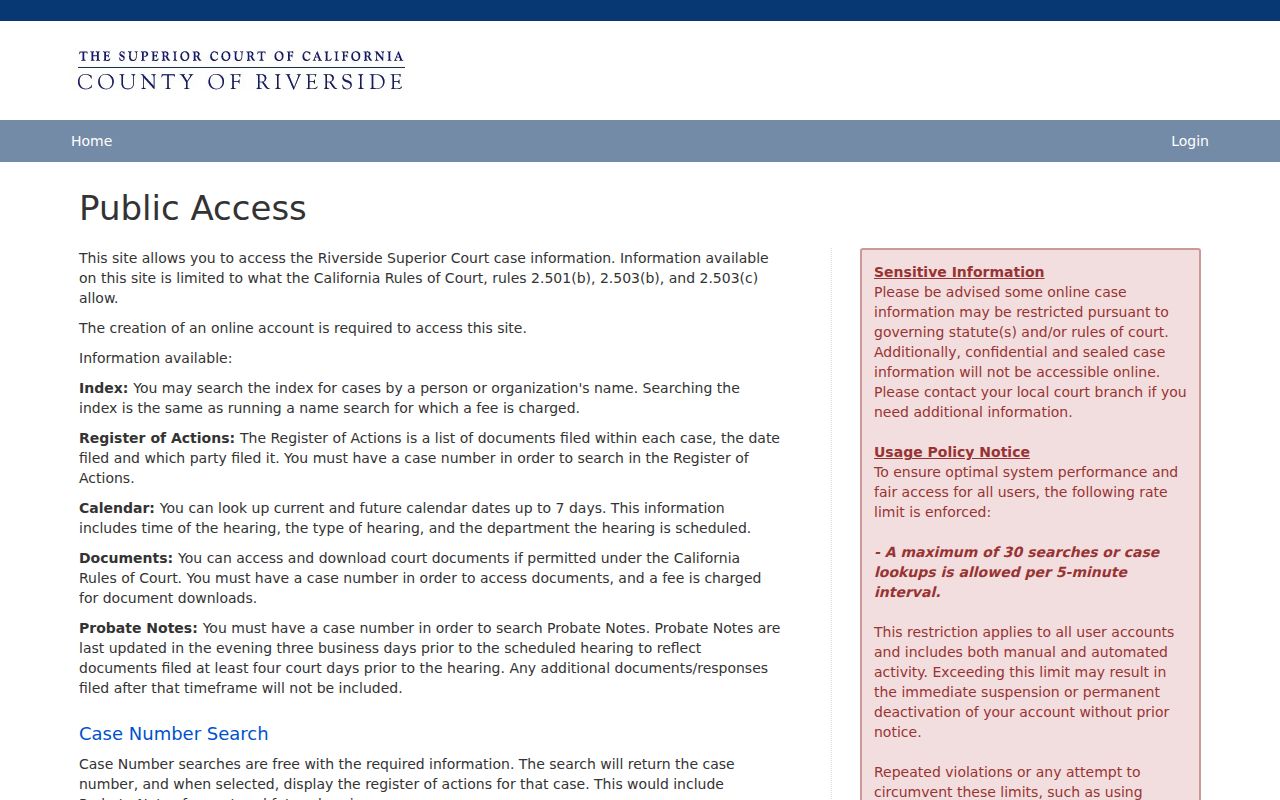
The court-search image is a reminder to choose the case class and access mode before reading a result. Online data is not the official court record, and protected family, juvenile, sealed, adoption, and confidential material stays out of public view.
A public docket result may contain:
- Case number, filing date, title, case type, and courthouse.
- Party names and roles, including plaintiff, defendant, petitioner, respondent, or another listed role.
- Register-of-actions events, hearings, disposition or status, and dates.
- Document links or purchase choices only where the portal permits access.
- Redactions or omissions for protected personal, victim, minor, financial, or confidential information.
Indio Resident Lookup Identity Check
Use two stable facts before searching a common name. A middle initial, former surname, approximate date, APN or address, spouse or relative, profession, case number, license number, or entity number can separate two people. Riverside’s recorder search expects last, first, middle ordering and supports wildcard and sounds-like operators. An asterisk can stand for multiple characters, a question mark for a possibly incorrect letter, and a trailing dollar sign for phonetic matching.
Keep a dated evidence ledger. Record the custodian, exact query, access date, indexed name, role, record date, geography, stable identifier, visible or redacted fields, and copy or order reference. Mark each result as identity support, ownership evidence, mailing contact, historic listing, professional affiliation, or a same-name lead. A deed grantee tied to a matching APN confirms an instrument relationship. A court party at the Indio branch does not prove current Indio residence.
- Anchor the name to an address, APN, case number, event date, or other independent fact.
- Search the Riverside court index and recorder index with exact, variant, and compound-surname forms.
- Compare dates, roles, geography, and stable numbers rather than joining records by name alone.
- Use a vital, license, business, probate, or historical source to test the strongest remaining link.
- Save the custodian’s retrieval date and order a certified copy only when the official document is needed.
- Docket
- The court’s case-level record of filings, events, hearings, and status. A docket entry is not always the underlying document.
- Index versus image
- An index is a locator with names and metadata. An image is the scanned or viewed document that supplies the fuller text, subject to access rules.
- Certified copy
- A copy issued and authenticated by the custodian for a purpose that calls for official certification. A plain downloaded page is not automatically certified.
- Disposition
- The recorded outcome or current status of a case. Read it with the case type, date, and party role.
Note: Stable identifiers and dates separate a useful name lead from an unsupported same-name conclusion alone.
Indio Assessor Counter Check
Riverside County’s online property tool can turn a street number and name into an APN and assessment facts. The Assessor intentionally does not display owner names online. Take the address or APN to an assessor office for public inspection. The closest full-service branch to Indio is the Palm Desert office at 38-686 El Cerrito Road, Palm Desert, with public hours from 8 to 4:30, appointments encouraged, and a drop box. It does not accept mail. The office phone is 760-863-7800.
Keep three address ideas separate. Situs is the physical parcel location. Mailing is where an assessment notice goes and may point elsewhere. The legal description ties the land to a subdivision, lot, or metes-and-bounds description. An assessed owner is an annual roll fact, not a complete list of people at the property. Non-owner occupants, children, roommates, and other household members do not appear as a public household list.
The Riverside County property tool is useful for the APN step. Then use the Assessor-County Clerk-Recorder official-records search to search a known party name and instrument date. Recorder indexing begins in 1974 online; earlier recorded-document research is directed to Gateway Riverside. The recorder index is name based, so verify the legal description on the image or copy.
Indio Vital Records Access
Riverside County handles local birth, death, and marriage copies, while the California Department of Public Health maintains statewide birth, death, fetal death or stillbirth, marriage, and divorce records. The right request depends on record type, copy type, relationship, and confidentiality status. California does not use one universal opening period for every vital series. A requester should not assume that age alone makes a record available.
| Birth | 2026 state fee $31; authorized copies for eligible people, informational copies where allowed |
|---|---|
| Death | 2026 state fee $26; eligibility differs by relationship and use |
| Public marriage | 2026 state fee $19; county of license or CDPH route |
| Confidential marriage | 2026 state schedule $19 where applicable; party or court order required |
| Divorce | 2026 certificate fee $18; court file access follows court rules |
CDPH applications ask for the record and copy type, names at birth, event date and place, parent names where relevant, number of copies, purpose, requester identity and relationship, contact details, signature, and payment. An authorized-copy request includes a sworn statement, and a mailed sworn statement must be notarized. Informational copies are marked as not valid to establish identity. CDPH does not email, fax, or issue a digital certificate, and it retains a search fee when no record is found.
Use the California vital-record application forms for the state route, then check Riverside County for an Indio event when a local copy may be faster. Confidential marriage and adopted-birth records stay restricted under the rules described by the custodian.
Indio Resident Lookup Licenses
California business and professional systems can verify a public affiliation, but an address of record is not proof of a person’s home. California bizfile’s main field is “Search by name or file number.” Its Business and UCC tabs, Contains or Starts With options, Search Type, Entity Type, Status, and Initial Filing Date range help narrow a name. The closest 500 matches appear by default unless the query is refined. Entity detail can show a legal name or number, formation or conversion date, status, jurisdiction, street or mailing address, agent for service, Statement of Information due date, and filing history or PDFs. It does not establish beneficial ownership, telephone, email, or residence.
The Department of Consumer Affairs basic search asks for Boards and Bureaus, License Type, License Number, Business Name, First Name, Last Name, and Search. Advanced controls add Registry Number, board or bureau, license type, city, county, primary or secondary status, public records or discipline, and public documents. Separate official searches cover the California Bar, contractors, real estate, educators, health professions, and liquor licenses.
The California bizfile business search and DCA license search are useful when the question concerns a named entity or credential. New entities registered after December 22, 2025 receive a 12-character identifier beginning with B. Filing or license results should be labeled as affiliation evidence, not residence evidence.
The California Bar license search shows the kind of official professional record that can help resolve a name variant.
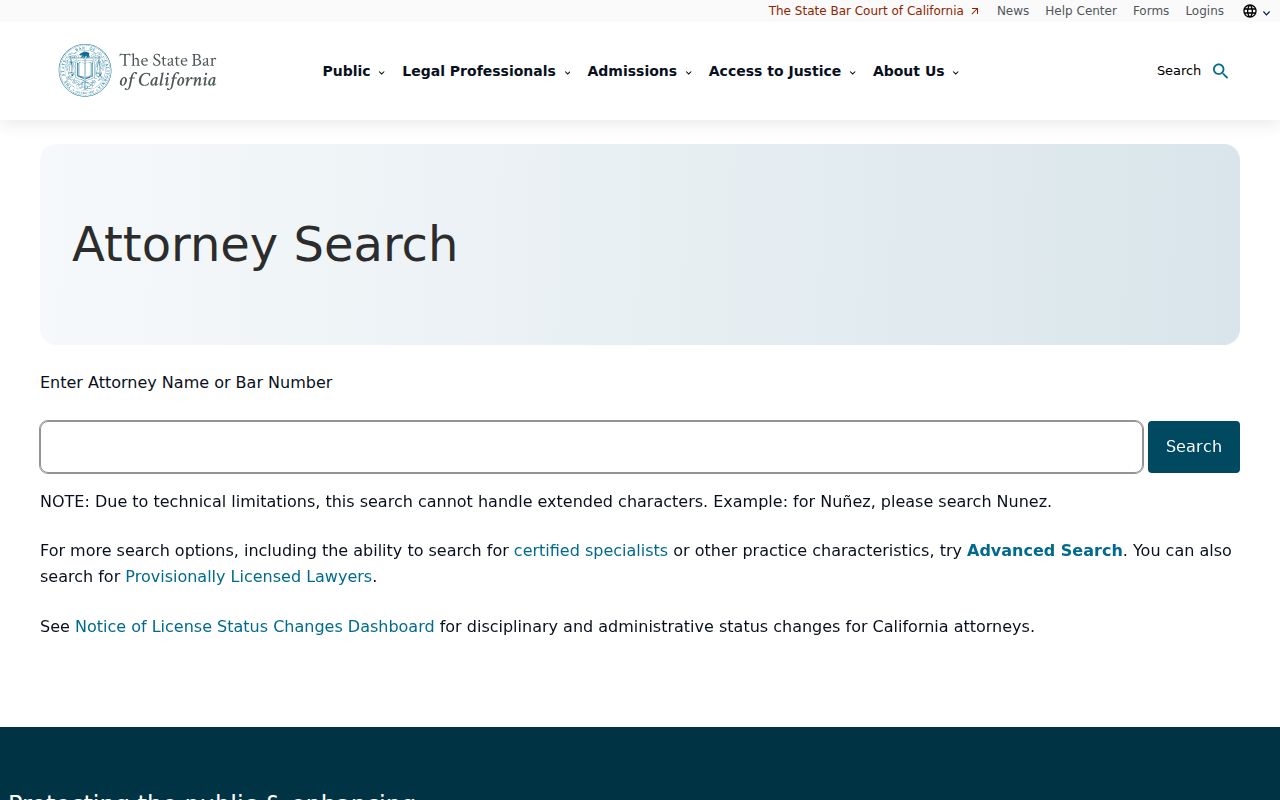
The license-search image belongs beside the affiliation caution: status, contact, discipline, and professional address can identify a credentialed person without locating a private household.
California Voter Status Limits
California’s My Voter Status tool verifies a voter’s own record. It is not an open block or neighbor directory. Public voter information is limited by Elections Code §2194 and related rules to approved election, scholarly, journalistic, political, or governmental purposes. Commercial use is prohibited and is a misdemeanor. A qualified requester may seek a statewide file for $100, a single-voter record for $30 each up to ten or a $100 maximum, or a Riverside County file at the Registrar’s county-set fee.
A permitted file may include name, date of birth, registration date, residence and mailing address, precinct, allowed contact information, party preference, and status. Inactive voters must be specifically requested. Optional history gives election date, type, and voting method, not ballot choices. Driver-license or state-ID numbers, the last four Social Security digits, unique identifiers, and signatures are excluded. Safe at Home participants and confidential voters are excluded or specially protected.
My Voter Status asks for first name, last name, date of birth, a California driver-license or ID value or the no-ID choice, Social Security number last four or the no-SSN choice, and CAPTCHA. Wait at least 24 hours after an online registration change. If neither authentication value is in the file, Riverside Elections is at 951-486-7200 and the Secretary of State is at 800-345-8683. These authentication fields are not released in a voter file.
A full voter-file request requires an application, a detailed statutory-purpose explanation, identity and security certifications, geographic scope, and delivery choices. The file fee is $15 per 1,000 records, with a $15 minimum and $100 maximum. The Secretary of State lists mail or hand delivery to the Elections Division at 1500 11th Street, 5th Floor, Sacramento, with published review of 7 to 14 business days.
Use California My Voter Status only for the voter’s own check. It cannot turn that check into a casual search by street.
Note: Voter data is powerful residence evidence only within the approved purpose and access rules, never as open browsing.
Indio Resident Lookup for Heirs
Probate is the official route when the purpose is to locate an estate, representative, or possible heir. Start with the Riverside court probate index, then read the petition, notices, and open filings that identify the estate relationship. Pair a probate lead with recorder instruments, death records, an obituary, and a cemetery or library source. An estate name can point to a family connection, but the probate file and custodian rules decide what can be copied.
Other personal research questions need their own path. A former classmate may be approached through a library yearbook or an institutional alumni channel. A birth-parent search should use California’s official consent and contact mechanisms because adoption records are confidential. A deceased resident can be checked through a death index or eligible copy, an obituary, and probate. The State Controller’s unclaimed-property search is a free clue, but a claim needs identity proof.
For a current person, two independent records remain the standard. Probate identifies a legal estate relationship. A deed identifies an instrument. A directory identifies a printed listing. None alone proves that every person in a family lived at the same address.
Privacy in an Indio Resident Lookup
California privacy rules deliberately interrupt address trails. Safe at Home can provide a substitute mailing address and support confidential voter registration, name changes, and DMV suppression for eligible people who fear for safety. Enrollment is through a designated assistance counselor and certification generally lasts four years. The program is not an identity change or witness-protection service, and it cannot erase every historic public document.
The California Megan’s Law registry is a separate public system with a use agreement, statutory exclusions, and limits on misuse. It supports name, mapped-address vicinity, city, county, and ZIP modes. Depending on the statutory category, a public result may show an alias, photograph, physical description, qualifying conviction, risk or registration information, and mapped residence. Not every registrant is posted, and the registry is not a general identity tool.
The California Megan’s Law search image shows why a visible result still needs its own legal and identity context.
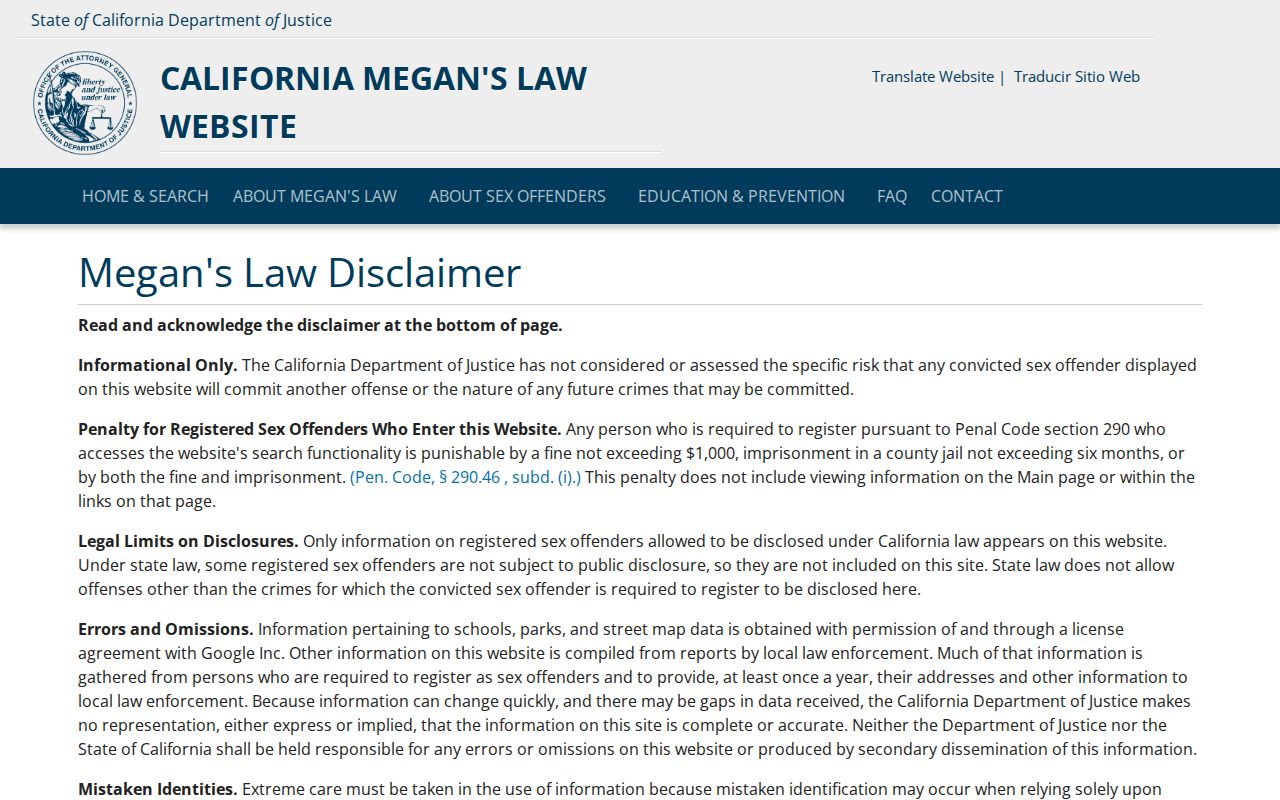
Use the registry’s stated rules, do not republish protected details, and never contact a person because a search produced a possible match.
Lawful personal use. An Indio resident lookup is for lawful personal research and verification. Do not use records to stalk, threaten, harass, intimidate, or harm anyone; California stalking and harassment laws can apply.
For a privacy request, California’s Delete Request and Opt-out Platform opened to residents on January 1, 2026. The free DROP process uses the California Identity Gateway, accepts names and former names, dates of birth, ZIP codes, email addresses, phones, advertising IDs, connected-TV IDs, and VINs, and returns an eight-digit request ID. Beginning August 1, 2026, registered data brokers must retrieve and process requests at least every 45 days. Submit through California DROP, then keep confirmations and follow up with an individual business when a record is missed or exempt.
Correcting an Indio Resident Lookup Record
Correction begins with the office responsible for the disputed fact. Ask the assessor about its roll, the recorder about an indexed instrument, the court clerk about a docket or copy, CDPH or Riverside County about a vital certificate, and a licensing board about license status. Preserve the old retrieval date and the new response. Do not repair one official record by copying a different person’s result into it.
For city-held records, Indio’s Public Records Center and City Clerk process requests under the California Public Records Act, Government Code §§7920.000 et seq. A request should identify the department, record type, subject, and narrow date range. The city makes an initial determination within ten calendar days, with a possible 14-day extension in unusual circumstances. The Act provides access to existing records; it does not require the city to create an answer or a new identity report. Use the Indio public-records request page for the city route.
When two records disagree, prefer the custodian whose system controls that fact and compare effective dates. A court case number, APN, document number, license number, or vital-record event date gives the office something precise to review. That correction path is slower than accepting a name match, but it leaves a defensible record of what was checked.
Note: A name match is a lead until an independent custodian, date, role, and geography support the same identity.